Wednesday, January 24, 2024

Rocky Krsnich

Rocky Krsnich was an infielder for the White Sox in 1949 and 1952-53.

Rocco Peter Krsnich (pronounced Kreznik) was born August 5, 1927, in West Allis, Wisconsin, a suburb of Milwaukee. His parents, Peter and Filimana, of Croatian descent, married in Yugoslavia and had their first child, August, there in 1912. Peter emigrated to the US in 1913; Filimana and August did not follow until 1922. Filimana gave birth to five more sons in Wisconsin.

The 1930 census shows the family living at 6016 Lincoln Avenue in West Allis, in a home they own, valued at $5000. Peter, 45, is a general laborer at a foundry; Filimana, listed as Philomena, is 38. August, 18, is shown as a daughter named Augustine (though his later World War II service will be as August) and is a clerk at a factory. Second son Rok had passed away in 1927, Joseph is five, Rocco, shown as Rudolph, is two, and Nicholas is one. Youngest son Michael is five months away from being born.

I can’t find the family in the 1940 census. In late 1944 Rocky started showing up in the Milwaukee newspapers as a basketball star for West Allis Central High School--the school didn’t have a baseball team but Rocky played American Legion ball. A January 31, 1945, article in the Milwaukee Sentinel mentioned that he was the leading scorer in the Suburban League and that he “is suffering from a badly infected arm and was held out of Tuesday’s practice session.” He signed a minor league baseball contract with the Phillies and seemingly left school before the 1944-45 school year ended.

On May 2 Rocky filled out a questionnaire in which he gives his nickname as “Rags,” his size as 6-0, 144, his off-season occupation as “student in high school,” and his hobbies as “none.” He was playing shortstop for the Wilmington Blue Rocks of the Class B Interstate League; he played 74 games and hit .266/.379/.369, but was released in early August.

On August 6, the day after his 18th birthday, while still in Wilmington, Rocky filled out his draft registration card. He is still 6 feet tall but has filled out a bit to 155 pounds; brown eyes, brown hair, dark complexion. His address is 6818 W Lincoln in West Allis, and he gives his occupation as “unemployed at present – student at West Allis Central High School.” He then went back home, and went back to school.


During the 1945-46 off-season Rocky played amateur basketball for three different teams, the Sorce Trucking Whiz Kids in the West Allis Minor league, Krahn’s Tap in the Milwaukee Suburban league, and Allis-Chambers in the Milwaukee Industrial league. On January 16, 1946, the Milwaukee Sentinel reported:

Chisox After Krsnich

“Rocky” Krsnich, former West Allis Central High basketball star, has been offered a Chicago White Sox baseball contract to play with its Waterloo, Ia., farm of the Three-Eye League. Terms called for $200 per month. However, before accepting, Krsnich is to confer with Brewer [Milwaukee of the Class AAA American Association] officials who have been after the outfielder [sic]. Last season he was a member of the Wilmington club, a Philadelphia farm.

On February 23 the Milwaukee Journal reported that Rocky had not yet signed the White Sox contract and was still hoping to hook up with the Brewers. But on May 24 he turned up playing shortstop and batting seventh for the Quincy Gems of the Class B Three-I League, a Yankees affiliate. After hitting .241/.297/.307 in 39 games he was sent down one level to the Joplin Miners of the Western Association. He didn’t do any better there, .204/.301/.299 in 60 games, but it would prove to be an important move for personal reasons, and the Yankees thought well enough of him to send him back up to Quincy for 1947.

After another off-season playing basketball around Milwaukee, he spent the baseball season with Quincy, playing shortstop. He began the year batting sixth but ended up in the second spot as he made large strides offensively, hitting .318/.421/.455 with 23 doubles, nine triples and three home runs. He played more basketball in the 1947-48 off-season.

For 1948 the Yankees kept Rocky at Class B but moved him to the Norfolk Tars of the Piedmont League. He got off to a great start and moved from fifth to fourth to third in the batting order, but cooled off and finished at .272/.363/.435, with 15 homers and 80 RBI, and was voted by the league’s managers to the all-star team. After the season the Yankees moved him up to the roster of Augusta of the Class A Sally League but not to the major league roster, where he would have been protected, and as a result he was drafted in December by the Class AA Memphis Chickasaws, a White Sox affiliate in the Southern Association.

Also in December, the Joplin Globe reported on December 2:

R.P. (Rocky) Krsnich, Joplin shortstop in 1946 and with Norfolk, Va., of the Piedmont League last season, like ball players before him, has married a Joplin girl. Ferrell Anderson, Al Gerheauser, Gabby Street and others fell in love with Joplin girls and incidentally, all later went to the major leagues after marrying them.

Rocky was married Saturday morning to Marie Hennessey, daughter of Mr. and Mrs. George V. Hennessey, 2518 North Highview avenue, at St. Peter’s Catholic church by the Rev. Father James Lyons.

The Memphis Commercial Appeal of March 24, 1949, reported that Red Ruffing, who was doing some spring training coaching with the Chickasaws “while waiting to take over his assignment as manager of Muskegon in the Central League,” said:

“I like that Rocky Krsnich at shortstop. Hell of a fielder with a great arm. I notice he didn’t hit too much but he drove in more than 80 runs. He can go to his right.”


Rocky started the season at short, but eventually got moved to third base. In the July 27 issue he got some attention from the Sporting News:

Chicks Quit Cellar on Krsnich’s Clouts

By George K. Leonard

NASHVILLE, Tenn.

…Three of the four games in the “crucial” series were decided by a one-run margin. In each contest the hero’s mantle was draped around the shoulders of Robert [sic] (Rocky) Krsnich, tall 21-year-old Memphis third baseman. Krsnich’s batting feats in the series which saw Memphis rising from the cellar for the first time this season included the following:

FIRST GAME—With the contest scoreless in the last of the eleventh, he homered with two aboard to win for his club, 3 to 0.

SECOND GAME—In the first frame, smashed a three-run circuit clout as Memphis prevailed, 4 to 3.

THIRD GAME—Drove in five of his team’s runs in a 9 to 8 win with a two-run homer and two singles.

FOURTH GAME—Whipped a line single to left field in the opening chapter, scoring two runs in a 3 to 2 triumph.

The recapitulation shows that Krsnich directly accounted for 13 of the Chicks’ 19 runs against Chattanooga with eight hits, including three homers, in 15 tries at bat. In the preceding series against Nashville, two of which were annexed by Memphis, Rocky collected six hits. All of this heavy knocking boosted his average from .258 to .285.


Milwaukee Journal, July 31:

West Allis Youngster Sets Pace for Memphis

A member of a noted West Allis athletic family may be the Milwaukee area’s next contribution to major league baseball. He is Robert [sic] (Rocky) Krsnich, 21 year old third baseman of the Memphis (Tenn.) Chicks of the Southern association, whose terrific batting spree last week almost single handedly pulled his club out of the league cellar…

Krsnich is better known to local fans for his football and basketball feats at West Allis Central high school, having won all-Suburban conference recognition in the cage sport in 1945. Since Central had no baseball team, his diamond activities were confined to junior American Legion and West Allis AAA league ball until he joined the New York Yankee organization three years ago [not quite true]. His younger brothers, Nick and Mike, had similar high school athletic careers…

The Chicago White Sox have first call on Krsnich’s services because of a working agreement with the Memphis club, so it will not be surprising if Rocky does his playing close to home next season.

Memphis Commercial Appeal, August 10:

Pouring Praise On Krsnich

And The Chick Third Baseman Deserves It—Rocky Raises Average And Homer Output

It is really pleasant to dwell on the virtues of Rocky Krsnich, a polite young man who is the current hitting sensation of the Southern League, especially since he is a member of the Chickasaws…This 22-year-old is the pacemaker of the Tribe now that the boys are seeing better days and he is not only hitting the ball at a lively clip, but he is fielding beautifully around third…His batting average through last night’s game was a respectable .313 and this represents a considerable gain for he fell down to the low .200s for a while…Furthermore his run-batted-in total stood at 65 and his home run output at 18…Now 18 homers for a righthanded hitter in this league is better than pretty good, for our parks aren’t built for that species of swinger…

Krsnick’s first name isn’t Robert, as reported on the reserve list, but Rocco, as he wants one and all to know…

All above ellipses are part of the article and not me showing that I’ve left things out. So I need to verbally state that I’m skipping ahead now.

Rocky started at shortstop and wasn’t exactly steady at the job…Furthermore, he wasn’t hitting too well and it was getting him down a little…”That’s where Al Todd came into it,” says Rocco. “He strung along with me, patiently explained my mistakes and told me to keep bearing down. He changed my batting stance a little to have me facing the pitcher a bit more and I picked up almost at once. He’s been simply swell to me and I think he did it all.”…Of course, the Chick manager disclaims the “all” part in view of the fact that Rocky has natural power and a good way of going…Although he played shortstop almost exclusively before coming to Memphis, he is confident that third base is his spot now and prefers playing there…So do the fans.

On September 10 Rocky’s contract was purchased by the White Sox and he was called up. With Memphis he had hit .318/.381/.527 with 38 doubles (tying for the league lead), four triples, and 20 homers, and 90 runs and 91 RBI.

Rocky made his major league debut on September 13 at Washington, playing third base and batting sixth in the lineup, behind Catfish Metkovich and ahead of Chuck Kress. In his first plate appearance he doubled off Dick Weik in the second inning. He also made two errors, each one leading to an unearned run, but the White Sox won 3-2 behind Randy Gumpert.

The next day Rocky went 3-for-5 with a double and three RBI; on September 21 at Yankee Stadium he hit his first major league home run, off Ralph Buxton. He played third base in 16 of the Sox’ final 17 games, starting 15 of them, and hit .218/.295/.364 in 55 at-bats. On October 12 the Memphis Commercial Appeal reported:

Rocky Krsnich, who went up to the White Sox when the Chicks finished their season, showed the parent club he’s a comer, but it’s likely that he’ll get that extra season of experience he needs right back in Memphis.


On December 21 Newman’s Department Store in Joplin ran an ad in the Globe to let the town know that Rocky had taken a job in their men’s department (The 1949 Joplin City Directory shows that Marie was a cashier for Newman’s, and that the couple was living at 501 Sergeant.) He went to spring training 1950 with the White Sox, but on March 22, as predicted, he was optioned back to Memphis. On April 10 an article appeared in the Commercial Appeal under Rocky’s byline, titled “How to Play Third Base:”

This is another in a series of articles which has been prepared by The Commercial Appeal in co-operation with the Memphis baseball team. The objective is improvement on the part of high school and sandlot players of the Mid South.

Next, Pat Seerey talks about hitting.

Rocky got off to a good start. He was voted utility man for the league’s all-star game, played July 18, in which the first-place Atlanta Crackers played against players from the other teams; but after that he had a variety of ailments and faded. The July 20 Commercial Appeal mentioned that he “is limping noticeably from a pulled leg muscle,” on August 16 they reported that he “was led off the field late in the game, for a reason not explained. He seemed to be suffering from dizziness.”

On August 18 the same paper said that he was out with a back injury, and on the 19th he was placed on the disabled list. From August 29:

Rocky Krsnich has come off the Chicks’ disabled list after being laid up with a back injury for two weeks…Rocky hasn’t any real good idea of how he picked up the ailment, but he played under a handicap for some time before being allowed a rest…He was back in action last night at Mobile.

He ended up hitting .272/.338/.408 with 12 home runs, numbers down significantly from 1949. He was added back to the White Sox roster briefly, then in December he was optioned to the Pacific Coast League’s Seattle Rainiers, in return for the right to purchase Rainier pitcher Vern Kindsfather.


Rocky spent the 1951 season with the Rainiers, where his manager was Rogers Hornsby. His hitting tailed off even more, and he started to be known for his glove. On August 15 the Portland Oregonian reported:

No longer is Rocky Krsnich, the Seattle third sacker, “the vowelless baseball player.” One Seattle baseball writer, Lenny Anderson of the Times, took pity on Krsnich’s vowelless state and generously gave him one—it’s now Kresnich when he writes about the young man.

A September 19 AP report on a playoff game between Seattle and Hollywood included this: “An error by Rocky Krsnich, generally regarded as one of the best glove men to ever perform at third base in the Coast League, started Seattle’s downfall in the ninth.” Rocky hit just .251/.314/.351 with four homers in 538 at-bats. Still, the White Sox put him on their off-season roster to protect him from the draft.


Rocky went to spring training 1952 with Chicago, but was optioned back to Seattle. His hitting bounced back some, and he continued to get raves for his fielding. From Frank T. Blair’s “Frankly Speaking” column in the July 11 Long Beach Press Telegram:

Manager Bill Sweeney of the Seattle Rainiers [replacing Hornsby] says that Rocky Krsnich ranks next to Pie Traynor as the best defensive third baseman he has ever seen. Krsnich is a pretty durable guy, too. He bounced up unhurt after a collision on the base paths with big Chuck Connors of the Angels Wednesday night, but the latter suffered another shoulder injury and had to leave the game.


As an aside, this is from Emmett Watson’s “Our City” column in the Seattle Post-Intelligencer of April 11, 1960:

This one digs ‘way back into sports history, but Chuck Connors, the TV star, credits an ex-Rainier ballplayer, Rocky Krsnich, for a big assist in his acting career. Only Rocky doesn’t know it. Connors, once a stout-hitting first-baseman for the old Los Angeles Angels, was churning around second base one night when he collided with Krsnich, the Seattle third-baseman, who had moved toward second for a possible play. Wham! Connors was upended, came down hard, suffered a dislocated shoulder. “I don’t know what he was doing there,” said Connors last week, “but he helped make up my mind about a movie career.”

Rocky was hitting .295/.339/.371 for the Rainiers when the White Sox recalled him at the end of July in an attempt to solve their third base woes. He started four games, going 2-for-10, after which manager Paul Richards decided to go back to Hector Rodriguez at third and use Rocky as a late-inning defensive replacement. On September 2, in the first game of a home doubleheader against the Tigers, he entered the game after Rodriguez had been pinch-hit for and hit a game-winning two-run triple in the bottom of the ninth off Virgil Trucks. This won him the job back and he kept it for the rest of the season, Richards saying, “He’s the best third baseman I’ve ever seen.”
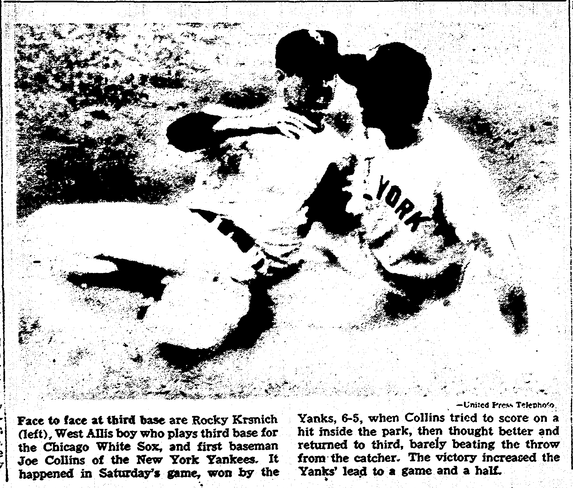


On September 14 Rocky won a game at home against the Red Sox with a bases-loaded single with two out in the 17th inning. The next day he broke a 2-2 tie with a two-run bases-loaded single in the bottom of the eighth. From the September 16 Chicago Daily News:

Sox Call Krsnich ‘Another Kamm’

Face Athletics Twice Tonight

By Neil R. Gazel

Have the White Sox another “Willie Kamm” playing third for them in graceful Rocky Krsnich?

Batting coach “Doc” Cramer thinks so. And Bucky Harris, another contemporary of the former Sox and Cleveland star concurs.

“He reminds me a lot of Kamm. I’m not kidding,” asserted Cramer.

“He does at that,” conceded Harris after Krsnich whipped his Senators last Wednesday both afield and at the plate.

With Chicago Rocky hit .231/.327/.385 in 91 at-bats in 40 games. From the October 23 Milwaukee Journal:

Krsnich

West Allis Lad Looms as Third Baseman for Chisox Next Season

By Sam Levy

It is not too early to predict that Rocky Krsnich, former West Allis Central high school athlete, may be the regular third baseman for the Chicago White Sox next season. Frank Lane, general manager of the Comiskey forces, himself foresees it. Krsnich’s play in the final month of the American League season was a pleasant surprise to everybody on the club. The Sox recalled the suburbanite from Seattle (Pacific Coast League), where he had starred in 118 games.

“Krsnich will get a chance to win the job next spring,” Lane told the writer recently. “I’ve liked Rocky ever since I first saw him play when both of us were in the Yankee chain. We drafted him shortly after I joined the White Sox in the fall of 1948.”…

“When we sent Krsnich to Seattle, we expected him to hit well but we were surprised by the remarkable improvement in his fielding,” said Lane.

Bill Sweeney, Seattle manager and a former Cleveland infielder, is one of Krsnich’s biggest boosters. He says: “I have seen almost all of the great third basemen, but I have never seen anyone play it so well as Krsnich.”

In December Rocky signed a 1953 Chicago contract; on the 28th Porter Wittich, in his “Globe Trotter” column in the Joplin Globe, mentioned:

Which reminds me that Rocky Krsnich, former Miner shortstop and now a full-fledged member of the Chicago White Sox, is “home” in Joplin for the holidays before departing soon for Florida and spring training…

Rocky reported early to spring training for a “finishing school camp” for him and eight other young players that opened January 19. By the end of the month the White Sox had optioned Hector Rodriguez to Syracuse and obtained infielder Fred Marsh from the Browns to give themselves another third base option. Another trade brought Ferris Fain from the Athletics; a January 28 AP story quoted Paul Richards as saying: “We now have the finest defensive infield in the league—Rocky Krsnich on third, Chico Carrasquel at short, Nellie Fox at second and Fain on first.” Another AP story from the same day attributed an almost identical quote to Frank Lane, only he said “either Rocky Krsnich, Sam Dente or Fred Marsh at third.”

On February 9 Lane made another trade, this one bringing Vern Stephens from the Red Sox. From the next day’s Chicago Daily News:

“We aren’t saying he’ll get the third base job over Rocky Krsnich or Fred Marsh,” explained Lane. “But we think the gamble for him is well worth taking.”


On March 27 the Milwaukee Journal reported:

Krsnich, who finished last season with the club after being called up from Seattle, has been hitting above expectations, especially with men on base, and is giving Stephens a battle for the third base assignment. He is much the surer fielder of the two and covers more territory,

Memphis Commercial Appeal, April 1:

When Rocky Krsnich was employed by the Chickasaws, he was not known as a master of the leather…But Rogers Hornsby now describes him as the finest fielding third baseman he has observed, and Stan Hack concurs in the opinion.

Atlanta Journal, April 8:

Slumping Stephens Opens Way For Chisox’ Krsnich

By Bob Christian

How much Rocky Krsnich, former Memphis Chick, will play for the Chicago White Sox depends on Vern Stephens, slugging third baseman acquired from the Boston Red Sox in late winter.

Between rings of the telephone in his 11th floor hotel suite Wednesday, it was easy to see that Paul Richards, lanky skipper of the White Sox, has high regard for Krsnich.

After a friend called and offered to sell him some flat land in Texas, the former Cracker skipper sat down and started talking about Krsnich, the hot flash of the Chisox’ training season.

“Krsnich used to be stronger at the plate than in the field,” Richards said.

“Now the guy is a whale of a glove man and it’s entertaining for me to watch him. There have been guys who might be quicker with the flip throw to first after coming in for a slow roller but when Krsnich’s in his normal position he is something to watch now.”

His battle with Stephens will depend on how the former Red Sox star comes through at the plate.

“When we got the guy from Boston I wasn’t worried about his hitting. It was his leg. He seems to have recovered but he’s had only one base hit in the 11 or 12 games we have played since leaving California.

“However, I checked up and I’ve learned that Stephens has never been much of a spring hitter,” Richards said. “Our trainer said he was with Stephens one spring and he didn’t get a base hit. Then I remember taking the Atlanta club over to Anderson, S.C., one afternoon. Stephens played against us and he struck out three or four times. So I guess there is nothing to do but wait for the bell.”

But if something should happen to Vern’s batting eye then “Slug” will have the fellow who has developed into one of those things with a glove.


On April 12 the Boston Advertiser’s “Baseball Forecast” passed along the following:

Royal Brougham of the Seattle Post-Intelligencer offers two long shots: 1—That Rocky Krsnich at third base for the White Sox will make Bill (The Glove) Cox look like a “butter-fingered fumbler” and that Freddie Hutchinson, youngest manager on the big wheel, will surprise everyone with the job he does at Detroit.

The season opened on April 14 with Stephens playing third and batting cleanup. He didn’t hit, and after seven games Rocky replaced him. But Rocky didn’t hit much either, and also had problems in the field, so after six games Stephens got the job back. When Stephens continued to struggle at the plate Rocky was reinstated in late May; his fielding, at least, improved, but on June 9 he dislocated his left shoulder while sliding, the prognosis being that he would be out at least three weeks.

At this point Fred Marsh was given the third base job, but after a week Lane made a trade with the Browns for Bob Elliott, who held on to the position for the rest of the year. Rocky returned to the team in mid-July, started for a week during an injury to Elliott, and finished the season as Bob’s backup. He hit .202/.270/.287 in 129 at-bats in 64 games, while in the field his percentage fell from .959 to .929 and his range per nine innings from 4.07 to 3.32.

From the December 9 Milwaukee Journal:

Major league ballplayers Johnny Logan of the Braves, Harvey Kuenn of Detroit and Rocky Krsnich of the White Sox will be guest speakers at a father and son night at the West Allis Kiwanis club at the Tanner-Paul American legion post Thursday night.


Thursday was the next day, the 10th, and that same day Rocky was traded with Saul Rogovin and Connie Ryan to the Reds for Willard Marshall. He went to spring training 1954 with Cincinnati but on opening day of the Reds’ season he was sold to the Portland Beavers of the Pacific Coast League. That day, April 14, the Oregon Journal reported:

Krsnich is driving from his home in West Allis to Portland and is due to arrive here in time to don a Beaver uniform for the opening game of the season Tuesday [20th] with Sacramento.


Yet the April 16 Cincinnati Post published a photo from the Reds-Cubs game of the 15th, played in Milwaukee, that showed Rocky in uniform for the Reds. Once in Portland he didn’t become the regular third baseman until May, then replacing Don Eggert, who was moved to the outfield. On August 17 he stole home as part of a triple steal. He hit .252/.306/.366 with nine homers in 511 at-bats in 142 games, but his 77 RBI were second on the team. His fielding numbers improved.


Marlowe Branagan’s “Tower Lights” column in the September 14 Oregonian, devoted to the Beavers players departing for the off-season, included:

Rocky Krsnich, another silent young man, dressed in rapid fashion. He will likely return to his home in West Allis, Wis., and his family was ready for a long drive home.

That same day Emmett Watson in the Seattle Post-Intelligencer reported that the Rainiers were going to try to reacquire Rocky. On October 17 the Joplin Globe reported that “Kansas City has an all-star team of ball players ready to do some barnstorming, including Jay Sousley, Kite Thomas and Rocky Krsnich, all former Joplin Miners.” I didn’t find any more references to that, though. From the October 31 Oregonian:

…What will be the lot of Rocky Krsnich is up to new owners.

Krsnich was just so-so here this past season. He didn’t hit the long ball in frequent fashion and there were many days when he didn’t hit, period.

On December 30 it was reported that the Beavers had turned down Seattle’s offer of Leo Thomas for Rocky, but the Rainiers were still interested.


On January 15, 1955, he was traded with pitcher Jehosie Head and cash for Seattle’s Artie Wilson. The Post-Intelligencer’s Royal Brougham said in his January 21 “Morning After” column that “Rocky Krsnich is the best fielding third baseman since Dick Gyselman and even big Dick couldn’t handle bunts so deftly as Rocky.” And from the February 2 P-I: “Seattle is my favorite town and I’m sure I’ll have a big year with the Rainiers,” is the word from Rocky Krsnich.


However, in 1955 Rocky started having serious throwing problems. He made ten errors in his first seven games, and 16 in his first 23. In mid-May the Rainiers got Lou Ortiz on option from the Phillies, put him at second base and moved Monty Basgall to third. Seattle optioned Rocky to the Tulsa Oilers of the Texas League; with the Rainiers he had hit .231/.313/.325 in 117 at-bats in 34 games, and made 19 errors for an .847 fielding percentage.

On May 24 Rocky made two errors in his debut game with Tulsa. On June 2 the Tulsa Daily World reported:

Tulsa’s biggest problem continues to be third base where Rocky Krsnich has failed to come up to expectations. He has been an improvement but not to the extent Schenz and Grayle Howlett had looked for. Krsnich has made some costly errors and has not hit much.

Back in Seattle, Emmett Watson wrote in the June 7 Post-Intelligencer:

The Rainiers estimate that a “normal” year from Rocky Krsnich would have them about even with San Diego—notwithstanding the Padres’ spectacular surge. Bad throws by Rocky cost Seattle at least six games.


Rocky’s throwing troubles continued with Tulsa, though his hitting improved some and he kept his job all season. The Dallas Morning News reported on August 21:

An oddity of the game was the fact that in the eighth inning, Tulsa’s third baseman, Rocky Krsnich, threw his left shoulder out of place while sitting on the bench. But it had happened before to him; a doctor was summoned from the stands, and he snapped it back into place. Krsnich, next up, went to the plate and swung without apparent difficulty, although he popped out to short.


With the Oilers Rocky hit .263/.325/.377 in 438 at-bats in 120 games. He made 46 more errors, giving him 65 for the year between the two teams, and his range fell off from his time in Seattle. But on October 14 Tulsa purchased his contract from the Rainiers, “on a conditional basis, pending the outcome of a shoulder operation which he hopes will correct an ailment he suffered last season.” (Tulsa Daily World)

The 1956 Joplin city directory lists Rocky as a ball player for the Tulsa Oilers, living at 2518 Highview Avenue, his in-laws’ house. On April 6, 1956, the Daily World reported that “A shoulder operation figures to help his erratic throwing of last year.” Rocky started the season playing third and batting third, though others were tried at the position. In mid-May, after playing in 16 games, the Oilers apparently returned him to Seattle, as in early June the Rainiers sold him again, to the Texas League again, this time to Oklahoma City.

Rocky got into 29 games with Oklahoma City, then presumably was released. Between the two Texas League teams he hit .268/.348/.384, his best showing since 1950, in 164 at-bats in 45 games, but he fielded just .885. After that he is supposed to have spent some time with the Dickinson Packers of the independent Manitoba-Dakota League, but no stats exist. This ended his professional career.


In 1959 Rocky appeared in the Wichita city directory, as a representative of the CIT Corporation, living at 429 N. Pershing Avenue. 1959 is also when he returned to the sports pages, as a member of the Wichita Cessna team in the National Baseball Congress’s tournament for semi-pro and amateur teams, held late each summer in Wichita. In 1960 the Wichita city census found Rocky, Marie, and their three kids at 429 N. Pershing.

The 1961 Wichita directory shows Rocky still working for CIT but now living at 1005 Wicker. Each year from 1961 through 1963 he played for the Wichita Rapid Transit Dreamliners in the NBC tournament; in 1962 they won the tournament and Rocky, still just 35 years old, was named the most valuable player. In 1964 he played in the tournament for Wichita’s Bob Moore Oldsmobile.

On July 31, 1967, L.H. Gregory mentioned Rocky in an installment of his “Greg’s Gossip” column in the Oregonian, devoted to Dick Radatz:

…Radatz isn’t the first baseball player to lose his throwing rhythm…

“I can cite a case closer to home,” said Lenny Anderson, baseball writer for the Seattle P-I. “In Rogers Hornsby’s 1951 Seattle pennant year, Rocky Krsnich, whom you always called ‘the shortstop with the missing vowel’ and generously supplied him with one, was a fine fielder with an exceptionally strong and accurate arm. Suddenly he began making bad throws to first and it got worse—he couldn’t seem to make a good one. Eventually he to some extent regained his rhythm, but never completely. The next year he was with a different team and my impression is that his baseball life was shortened.”

Rocky’s father passed away in 1969, and his mother in 1981. Marie died in 2004. Rocky’s youngest brother, Mike, who had played professional baseball from 1950 to 1969, including time in Mexico and Japan and 15 games for the Milwaukee Braves in 1960 and 1962, died in 2011; brother Nick, who played in the low minors in 1950 and 1951, followed in 2014. Rocky himself passed away at age 91 on February 14, 2019, in Overland Park, Kansas.

https://www.retrosheet.org/boxesetc/K/Pkrsnr101.htm

https://www.baseball-reference.com/players/k/krsniro01.shtml

Sunday, November 26, 2023

Chuck Wolfe

Chuck Wolfe pitched in three games for the 1923 Philadelphia Athletics.

Charles Hunt Wolfe was born February 15, 1897, in Wolfsburg, in south-central Pennsylvania, the youngest of six children of blacksmith Albert Wolfe and Sarah Whetstone Wolfe. Albert and Sarah were both from Pennsylvania and they started their family there, but their second and third children were born in North Dakota before the Wolfes returned to Pennsylvania.

The 1900 census finds the Wolfes living in Mann’s Choice Borough in Bedford County. Oldest child George is already a schoolteacher at age 18; Glenn is 15, Annie 11, Grace 9, and Charley 3. 13-year-old Pearl has been shipped off to be a servant for Sarah’s brother George Whetstone and his family.

In the 1910 census the family lives on Market Street in Napier Township, still in Bedford County. Albert is still a blacksmith at 57, Sarah is 56, George is 27, still teaching and still living at home. Annie, now shown as Anna, is 21, Grace is 19, and Charley is 13; Glenn and Pearl are both married and living elsewhere.

Albert passed away in 1913. I didn’t find anything about Chuck between the 1910 census and June 5, 1918, when he filled out his draft registration card. He gives his name as Charley Hunt Wolfe, his address as Schellsburg (in Bedford County), his employer as the State Highway Department, near Schellsburg, his nearest relative as his mother, also of Schellsburg, and his appearance as light brown eyes, light brown hair, medium height and medium build.

In 1922, at age 25, Chuck was mentioned in the March 9 Sporting News as being one of the pitchers at the Philadelphia Athletics’ training camp. But the March 16 issue reported:

At this writing everybody on the roster had reported excepting Pitcher Ed Rommel, First Baseman Joe Hauser and Pitcher Wolfe. The last named has permission to finish his studies at college and will not report until June.

However, by late April Chuck was pitching for the House of David barnstorming baseball team. The House of David was a religious sect from Michigan, and it had a baseball team that traveled the country playing against local teams. They were known for their long hair and beards; when they hired ringers, such as Chuck Wolfe or an aging Grover Cleveland Alexander, sometimes the players grew out their hair and sometimes they wore wigs.

The first mention of Chuck with the House of David that I found was in the April 30, 1922, Evansville Courier:

The Evas defeated the House of David team yesterday in the first of two exhibition games, 4 to 2…

Wolfe, the House of David twirler, was in rare form and served up some mighty sweet curves for the local boys to glance over. This was the first real chance the Evas have had to hit curve pitching and they did well…

Chuck spent the year with the House of David. In the games that I found where he was mentioned as pitching the team was 1-5 with two ties; a 1924 article says that he won 42 and lost 9 for them, which seems unlikely.

On August 2, 1923, Chuck made his major league debut with the Athletics. I found no mentions of his pitching for anyone earlier in the season than that; it’s possible that he was being carried on the Philadelphia roster but not being allowed to pitch in any league games. On this day, at home against the Tigers, he relieved Rollie Naylor to begin the sixth, down 3-1. In his first inning he retired Bob Jones, Ty Cobb, and Harry Heilmann around a walk to Heinie Manush, but in the seventh he allowed three runs; the Athletics scored four in the eighth and ninth and lost 6-5. Chuck singled in his only plate appearance.

Chuck next pitched on the 13th, at home against Cleveland in the second game of a doubleheader. He relieved starter Slim Harriss with two out in the fourth, following a three-run homer by Tris Speaker that put the Indians up 7-2. The first batter he faced, Joe Sewell, hit his third and final home run of the season, but Chuck finished the game without giving up another run and the Athletics made it close, losing 8-6. The next day’s Cleveland Plain Dealer, in their story on the game, called Chuck “an ambitious youngster who has been with the Quakers only a short time.”

On the 18th in Cleveland, Chuck pitched to one batter, replacing Curly Ogden with two out in the bottom of the eighth and the bases loaded and retiring Rube Lutzke for the final Indian out in a 16-3 Athletic loss. This was his final major league appearance, though he remained on the Philadelphia roster and pitched for them in some exhibition games, including August 21 vs. Milwaukee of the American Association and August 29 vs. Worcester of the Eastern League. In his three official games he had a 3.72 ERA in 9 2/3 innings, allowing six hits while walking eight and striking out one.

On October 8 Chuck was sold to the Portland Beavers of the Pacific Coast League. The next day’s Oregon Journal described him as “a six-footer,” and the January 15, 1924, Oregonian called him a “strapping young fellow,” but the same paper on March 4 got it right, once they actually saw him:

Wolfe is short and almost squat in appearance, due to the tremendous breadth of his shoulders and depth of chest.

He weighs 175 pounds normally and is five feet 7 inches tall, but few would guess him to be more than five feet five, so close to the ground is he built. He comes with a reputation for great speed, and he looks the part.

Chuck impressed in spring training, which was at Stockton, California. From the March 14 Oregon Journal:

In speaking of the pitching squad, Turner declares that Charles Wolfe is the best looking pitcher of the new comers and concedes the former House of David hurler a place on the regular staff. Wolfe is a pitcher built along the lines of the late Gene Krapp, although somewhat bigger and heavier than “Rubber.”

(If you’re thinking, “Gee, I’d sure like to read a biography of Gene ‘Rubber’ Krapp,” see here:

https://sabr.org/bioproj/person/Gene-Krapp/)

The March 24 Los Angeles Daily News ran a report on the Portland team that touted two newcomers: Mickey Cochrane and Chuck. Chuck had a rough time in an intrasquad game on April 5, allowing 12 runs in five innings; the report in the next day’s Oregon Journal included the following tidbit:

The weather was almost perfect, the sun shining down with midsummer intensity. The game was stopped in the fifth inning to permit the Ku Klux Klan to rehearse a ritual that they are going to stage at an initiation at Oak Park tonight.

Despite this performance, Chuck was still well thought of, the Portland News saying on the 9th that he “looks the class of the young right handers. He will no doubt be kept.” 


The season had opened the day before, but Chuck didn’t get into a game until the 15th, when he pitched the last two innings of a 12-3 loss in Sacramento, giving up the final run. It doesn’t sound like a particularly bad outing, but the Beavers had seen enough of him, as seen in the May 14 Oregon Journal:

Pitcher Wolfe Is Sold to Bridgeport

President Klepper of the Portland Baseball club announced Tuesday night [13th] that Pitcher Charley Wolfe had been sold by Scout Tom Turner to Bridgeport, Conn., in the Eastern league. Klepper received a wire from Turner asking Wolfe to leave for the East at once, and the latter will pack his bag and begin the transcontinental journey this morning.

Wolfe, who came to the Beavers this season, was in one game for a few innings during the opening series in the South, but his showing was not up to expectations and he was left behind when the Beavers left for Seattle last week.

This was a step down, from AA to A. Chuck pitched for Bridgeport the rest of the season. The June 28 Springfield Republican mentioned that he had won four games in the previous week, but his record for the season was 11-12, with a 3.55 ERA in 208 innings in 32 games. He was on the Bridgeport reserve list the following off-season.

Chuck returned to Bridgeport for 1925, and was their opening day starter, pitching a complete game but losing 2-1. He had a 2-1 record and 2.12 ERA in 34 innings in five games when, on May 13, as reported in the next day’s Bridgeport Telegram, this happened:

CHUCK WOLFE HURT AS LOCALS TRIUMPH, 4-1

Fractures Kneecap While Attempting to Score in Fifth—Eddie Burke Features.

…Chuck Wolfe, who started on the mound for Bridgeport, fractured his knee in the fifth inning when he attempted to score from third base on a delayed double steal with Henzes. He had to be carried off the field and will be out of the game for several weeks. Wolfe was pitching steady ball, having held the visitors to five scattered hits. He did not allow a pass and had retired four men on strikes.

The prognosis was not so good on June 5:

Chuck Wolfe will be out of the hospital this week. His leg is still in a cast and will be so for three weeks. He will probably be on crutches for a month following this. It is certain that he will not play ball again this year.

It was certain, and he did not. Chuck returned to the team for spring training 1926. The Bridgeport Telegram reported on March 16:

With Chuck Wolfe in none too good condition; Frank Wotell not wanted; Joe Burns about all done; and Bob Caffrey nursing a bad injury received in football, the prospects of the local team are exceedingly poor.

Chuck started the regular season with Bridgeport but, with a 5.21 ERA in 19 innings in six games, he was released on May 19. He hooked on with the Manchester Blue Sox of the Class B New England League, where he finished the season, going 15-10 with a 3.56 ERA in 202 innings in 29 games as the Blue Sox won the league championship.


Chuck returned to Manchester in 1927. From the Lynn Daily Item, April 14:

JEAN DUBUC IS STILL THE BLUE SOX CLUB PILOT

MANCHESTER, N.H., April 14, 1927.—Replying yesterday to reports from Worcester that he had been signed as manager of the East Douglas club of the Blackstone Valley League, Jean Dubuc made emphatic denial that he is to leave Manchester this season…

In the course of the conversation with Dubuc, he announced that Chuck Wolfe, star pitcher of the club last season and the ranking right-hander of the league, and Jake Wimer, veteran shortstop, have been sold to East Douglas. It was a cash proposition but no price was mentioned. Both will be placed on the voluntarily retired list, thereby remaining the property of the local club.

The Blackstone Valley League was a semi-pro league comprised of textile mill teams, which explains how the Blue Sox would retain ownership of Chuck and Jake while they played for another team, but does not explain why they would be sending their best pitcher to play semi-pro ball. But since the New England League season didn’t begin until mid-May, I suppose it was an alternative to spring training for getting them into shape, plus the team made a few bucks.

Chuck pitched for the Blue Sox on opening day, May 17, and threw a three-hit shutout while striking out ten. He stayed with them all season, though he and a teammate missed the Labor Day weekend due to having been loaned to East Douglas. Chuck finished with a 15-10 record, same as in 1926, though his ERA dropped from 3.56 to 2.61.

In 1928 Chuck returned to Manchester, but in mid-July he somehow made his way to Lewiston of the same league. Between the two teams he was 12-13 with a 2.70 ERA in 193 innings in 27 games.

Chuck was back with Lewiston for 1929. From the June 12 Boston Herald:

Chuck Wolfe, married today [the 11th], made a honeymoon out of the game with Lowell and the Twins won, 6 to 2. Wolfe held the Millers scoreless until the ninth, fanned six and walked only one man.

Chuck’s bride was Anna Catharine (known as Catharine) Horne of Bedford County; they were married in Lewiston. From the July 25 Springfield Republican:

HURLERS SUSPENDED

Lewiston, Me., July 24—(AP) William (Windy) Diehl and Charles (Chuck) Wolfe, pitchers on the Lewiston-Auburn club of the New England League, have been suspended, according to a statement issued today by Manager Jesse Burkett. Burkett said the two hurlers would have to tell the reason for the suspension. Richard Hunnewell, president of the club, said the two men had ordered [sic] to go to New York for examination by physicians, but had refused to comment further.

I didn’t find anything more about this, and both players were back in action by mid-August. Chuck had a 7-4 record and 4.05 ERA in 131 innings in 22 games.

In the 1930 census, taken April 24, Chuck and Catharine are living in Schellsburg, Bedford County, in a rented house. Chuck is a 33-year-old ball player; Catharine is 35.

Chuck returned to Lewiston, where he was again part of the starting rotation. From the June 20 Wilkes-Barre Times Leader: "York last night obtained a new pitcher, Charley Wolfe, who came here from the New England League, which circuit gives signs of breaking up."

The New England League did break up, two days later, and apparently nobody ever compiled the final statistics. I only found one game that Chuck pitched for York, of the Class B New York-Pennsylvania League, in relief on June 25. He didn’t appear in the NY-Penn stats, which means he didn’t appear in ten games and didn’t pitch 45 innings. His Sporting News obituary suggests that he went from there to the Johnstown Johnnies of the Class C Middle Atlantic League, but I didn’t find any details on that. This seems to have been the end of his professional baseball career, though in 1932 he was pitching for the Schellsburg town team, as reported in the June 3 Bedford Gazette:

SCHELLSBURG NINE BEATS SCALP LEVEL TEAM

As a part of the Memorial Day celebration, the Schellsburg baseball club, showing a tremendous batting power, swamped the Scalp Level team to the tune of 15-4.

Chuck Wolfe, a former pitcher for the Philadelphia Athletics, held Scalp Level to 7 scattered hits, most of the 4 runs being scored on errors of which Schellsburg had 6.

The 1940 census shows Chuck, Catharine, and six-year-old son Clive living in Schellsburg, in a house they own, valued at $1600. They lived in the same house in 1935. Chuck has an eighth grade education, is a laborer for a private estate, worked 18 hours in the last week of March, worked 32 weeks in 1939, for which he earned $470. Catharine is 45 and has two years of college.

The 1950 census shows them living on Pitt Street in Schellsburg, in the “last house before bank.” Chuck is 53 and unable to work, Anna is 55 and keeping house, and Clive is 16.

On November 27, 1957, Chuck passed away in Schellsburg, at age 60. His death certificate gives his occupation as school custodian, and the cause of death as carcinoma of left lung, which had been diagnosed four months previously. The Associated Press reported on his death on November 28, shown here as it appeared in the Washington Evening Star a day later:

Ex-A’s Hurler Dies

BEDFORD, Pa., Nov. 29 (AP)—Charles H. Wolfe, 60, of nearby Schellsburg, died yesterday at his home. He pitched for the Philadelphia Athletics during the 1923 season.

His obituary from the December 11 Sporting News:

Charles H. (Chuck) Wolfe, 60, who was signed as a pitcher for the Philadelphia Athletics by Connie Mack in 1923, died at his home in Schellsburg, Pa., November 27.

Wolfe appeared in three games with no decisions for the A’s. He was sent to Portland, Ore., in 1924, but was released to Bridgeport and subsequently performed with Manchester, Lewiston-Auburn, York and Johnstown before ending his career in 1930. His wife and a son survive.

https://www.retrosheet.org/boxesetc/W/Pwolfc101.htm

https://www.baseball-reference.com/players/w/wolfech01.shtml

Sunday, November 12, 2023

John Radcliff

John Radcliff played for four teams in the National Association of 1871-75.

John Young (or Yardell) Radcliff (or Radcliffe) was born June 29, 1848 (or 1846), in Philadelphia to John and Mary Radcliff. The 1850 census shows the family in Philadelphia County; John Sr. is a 32-year-old trunk maker, Mary is 29, Samuel 7, Catherine 6, John is listed as 4, and Mary 1.

In the 1860 census the family lives in Camden, New Jersey. John Sr. is still a trunk maker but has only aged 7 years; Mary has aged 9, Samuel 11, Catherine (now Kate) 10, John 10, and Mary 11, plus there is now 10-year-old Sallie.

At some point John started playing baseball, which in the 1860s was very different from today, or even from the 1890s, and not just in terms of the rules. There were no professional leagues, and ostensibly no professional teams, though many upper-level teams paid some of their players. In 1867 he made his way to the Athletic club of Philadelphia, one of the country’s top teams, as reported in the June 9 New York Dispatch:

We understand that the Athletics intend taking Radcliffe, a member of the Camden and Keystone clubs, on to Boston to catch for them. This is in direct violation of the rules, which say that a player must be a member of a club thirty days before playing in match games with them. Mr. Radcliffe is now a member of three clubs, and we advise the Eastern clubs to look out for him and enforce the rules. This borrowing men from other clubs won’t do.

“The rules” were the rules of the National Association of Base Ball Players, the governing body of “amateur” baseball. Despite the warning, John played right field for the Athletics against Lowell in Boston on June 13, and hit two of the team’s eight home runs as they won 53-8. He continued to play for the Athletic club, mostly catching. That year’s Camden city directory shows John Radcliff as a produce dealer, living at 420 Hamilton Street with Samuel; the Philadelphia city directory shows John Radcliffe with a butcher shop at 274 5th Street Market, but living in Camden. The 1870 census will show both Johns as produce dealers, but our John will go into meat and poultry after his father’s death, so perhaps he is the butcher.

On March 29, 1868, the New York Dispatch reported:

They had a good time on the Camden grounds, Camden, on the 17th inst. Al. Reach, Sensenderfer, Radcliff, Fisler, Kahmer, McMullin, D. Carter, Albertson, Borquin, Clarke, A. Howard, and several other well-known ball-tossers were upon the field, and sides were chosen, and a sharp game of six innings was played, resulting in favor of Radcliff’s side by a score of 21 to 15.

Philadelphia Inquirer, May 11:

The Athletic nine this season, will be composed of the following players: J.D. McBride, A.J. Reach, John Radcliff, Isaac Wilkins, Weston Fisler, Thomas Berry, John Sensenderfer, Edward Cuthbert, and their new player, Schaefer.

The Athletics made a tour of the western states, or what were the western states at the time, and on June 6 they defeated the famous Cincinnati Red Stockings, 20-13. The Cincinnati Daily Gazette reported on the 8th:

There was a good deal of excitement over the matter in the evening, at the hotels, in the saloons, and elsewhere. It is generally conceded that, on the whole, the game was the best that has ever been played in the West.

On June 18 John scored 12 runs as the Athletics defeated the Forest City club of Rockford, Illinois, 94-18. On July 25 the Camden New Republic reported:

BASE BALL—The Athletic Base Ball Club has lost the services of its catcher, Mr. John Radcliffe, of this city, he having sent in his resignation last Tuesday morning. On the previous evening he left for New York, where he has joined the Mutual Club and is expected to play in the game with the Atlantic on the 30th inst.

But five days later, in the New York Tribune:

Radcliffe has returned to Philadelphia, and rejoined the Athletics. It may be remembered that Radcliffe joined the Mutual Club of this city a week ago.

John finished the year with the Athletics, usually catching and batting third. He was recognized as a star, as suggested by this item from the Dodgeville (WI) Chronicle of January 22, 1869:

The gold medals offered by the New York Clipper to the nine base ball players making the best average during the season of 1868, have been awarded to Messrs. Radcliffe, McBride, Foster, Reach and Sensenderfer of the Philadelphia Athletics, Waterman and Johnson of the Cincinnatis and Wright of the Unions of Morrisania.

By this time it was being reported that John would be joining the Cincinnati Red Stockings, but it doesn’t seem to have actually happened, and instead he wound up back with the Keystone club of Philadelphia, one of the teams he had left for the Athletics in 1867. At the end of May it was reported that he had left the club, and on June 6 the New York Dispatch relayed the story:

Mr. H.R. Hellier, corresponding secretary of the Keystone Club of Philadelphia, in a letter to the Philadelphia Sunday Mercury, which we publish below, explains the rumors, and gives the facts in regard to the resignation of Radcliff from the Keystones.

Base Ball Editor Sunday Mercury: In the issue of the City Item, dated May 19, appears the following:

“Radcliffe, we hear, has resigned from the Keystone. A great loss. He wanted regular pay, as promised, and he should have had it. They’ll miss him.”

Radcliffe signed an agreement to play with the Keystones for the season of 1869, for $10 per week, which was paid him, viz: April 30, $10. He then said $10 per week was not enough to pay him for his time, so the club agreed to give him $15 per week. They paid him $15 on the 8th of May, and $15 on the 15th of May. On the 22nd of May Mr. Radcliffe called on me and said he had called at the Treasurer’s house and could not find him in. I asked him if he wanted any money, or would wait till Tuesday, when he would see the Treasurer on the ground. He replied that he would like some money then. I gave him $10—all the money I had in my pocket—and he went away perfectly satisfied. On Monday, the 24th, I received the following communication through the post:

                                                                                                                CAMDEN, May 22d, 1869.

To the officers and members of the Keystone Base Ball Club:--

I offer this as my resignation, for reasons to devote myself to the business duties of life. Wishing success to the club, I am very respectfully yours,

                                                                                JOHN RADCLIFFE, JR.

These are the facts of the case,

HENRY R. HELLIER, Cor. Sec. Keystone B.B.C.

John made his way back to the Athletics, with whom he traveled to Brooklyn for a game against the Atlantic club on July 5. The New York Dispatch reported on the 11th:

When the two nines finally presented themselves in attitude for play, much disappointment was felt at seeing Radcliffe in the Athletic nine, as his presence (not being entitled to play) made it evident to all that the game was to be a social one instead of a regular match game, as had been anticipated; and we were informed by a Philadelphia reporter who accompanied the Athletics that the intention all along had been to make the two first games mere contests for gate money, the regular matches to be played in the Fall. All this would have been overlooked, however, had a fine display of science and skill been afforded; but such was not the case, the fielding being the poorest shown by either club this season, four hours being occupied in getting the twenty-seven hands out on each side. The batting was the only redeeming feature, the display in this respect being certainly very fine, every man striking as though his sole aim and desire was to make a home run. Every player in both nines fielded miserably, dropping fly balls, muffing grounders, throwing wildly, in fact, conducting themselves like the veriest muffins, the few good points that were made being entirely lost in the avalanche of bad play.

John played the rest of the year with the Athletics, generally catching and batting eighth.

The 1870 census shows the family living in Camden. John Sr. is a 52-year-old produce dealer, with real estate valued at $1500 and personal estate of $1000. Mary is 48. Samuel is a 27-year-old produce dealer with $2200 in real estate, John is a 22-year-old produce dealer, Mary Jr. is 20, and Sallie is now Sarah and is 17. On March 14 the Cleveland Daily Herald reported in its “Base Ball Items” column:

…In other cities throughout the country the “busy notes of preparation” admonish us that the season of 1870 will be one of unusual activity. The Athletic Club of Philadelphia, the Champions of Pennsylvania, and long contestants for the higher title of “Champions of America,” have completed their nine as follows: …John Radcliffe, short stop…

That spring the Cincinnati Semi-Weekly Gazette ran position-by-position reports on the top teams in the country, covering the Athletics in their April 5 issue:

BASE BALL.

Leading Clubs of the United States

ATHLETIC, OF PHILADELPHIA

The Athletics, the pet club of Philadelphia, will make a determined struggle, this year; for the honor of being considered the best club in the United States, and also for the possession of the whip pennant, the emblem of the championship. They mean business, and present one of the strongest nines in the country with which to wrestle for the supremacy in our national game…

SHORT STOP.

Johnny Radcliffe, the “little Jerseyman,” will play short stop in the Athletic Nine, and will undoubtedly maintain his well earned reputation as one of the best players we have. “Red” joined the Philadelphia Club in 1867 as catcher, which position he filled during 1867 and 1868 in a style that has never been surpassed by any catcher, with the exception of Allison, of the Cincinnati club. Radcliffe is a splendid general player also, and a good change pitcher. He combines all the requisites of a first-class shortstop—pluckiness in facing all kinds of hot balls, agility and good throwing qualities. As a batsman he is one of the top lights of the fraternity, and although a very small man [5-6, 140], he can bat a ball a tremendous distance, and is also a very safe hitter and a good base runner.

He was engaged for the Red Stocking Nine in the early part of last season, but owing to the troubles he became involved in with his old club, he was released from his engagement to the Cincinnatis, and returned to Philadelphia. The Athletics will do well to retain him…

John did play shortstop, usually batting seventh. On June 22 the Red Stockings came to Philadelphia, and the Cincinnati Daily Enquirer reported:

To-day the Red Stockings achieved the greatest victory of their brilliant record, defeating the undoubted second best nine in the country, the best nine the famous Athletics ever presented on a ball-field, and the so-called champions of the United States, in the face of the partially unfriendly crowd of over 20,000 people, after a hard up-hill fight. The game, too, was played with an elastic ball, the choice of the Athletics, and therefore favoring batting rather than fielding, and long hits being in order, of course the Philadelphia players were the gainers when the ball was knocked into the crowd friendly to them…

John hit three singles and a homer, scoring four runs, as the Red Stockings won 27-25. On July 26 the New York World reported:

The Athletics appeared in their new uniform, consisting of light gray and blue plaid stockings, white flannel trowsers, with a white bow at the knees, a flesh colored silk shirt, with a short white flannel jacket, and a flat topped cap of the same material.

In October it was again reported that John would be joining the Red Stockings, but the team disbanded and he wound up back with the Athletics, now part of the newly formed National Association of Professional Base Ball Players, the first professional league, often considered retroactively to have been the first major league. The first game was played on May 4, though the Athletics didn’t play their first league game until the 20th.

John played shortstop and batted third in the order that season. The Athletics won the pennant with a 21-7 record; most games the teams played were not official league games. John hit .303 (the league average was .287), tied for third in runs scored with 47, and was second in fielding percentage among shortstops at .804.

After the season John signed with Baltimore for 1872. They finished in second place with a 35-19 record, while John led the league with 297 at-bats—and also with 74 errors, most of them at shortstop—hitting .290. As an indication of how much the game centered around putting the ball in play, he had two strikeouts and no walks.

John returned to Baltimore in 1873 and split time between shortstop and third base. He hit .287 but his extra base hits were down considerably.


The 1874 Camden city directory shows John Radcliff as a poultry dealer, Samuel Radcliff as a poultry dealer, and John Y. Radcliff as a gentleman, all at 556 Berkley Street. Maybe John Sr. had retired, or maybe our John was doing so well with the baseball thing that he didn’t need to work.

Early in 1874 John signed with a new team to the National Association, a second team for Philadelphia. Baseball Reference calls them the Philadelphia Whites, but at the time they were generally just referred to as the Philadelphia Club, as opposed to the Athletic Club of Philadelphia. In February it was reported that John’s contract was for $1200. From the Philadelphia Dispatch, March 22:

The Philadelphia nine, although new in composition and association, will be comprised of as strong players as the country can produce…At second base either Craver or Radcliff will probably flourish…Radcliff is also one of the most available infielders in the country, and will render great service to the Quakers during the season…

John played every position except pitcher and catcher for the Philadelphia Club, but most often in the outfield. In July he was accused of trying to enlist Umpire William McLean to help him and some teammates to throw a game to the Chicago White Stockings in Chicago. From the Chicago Tribune, September 4:

THE CHARGES AGAINST THE PHILADELPHIA CLUB.

Special Dispatch to The Chicago Tribune.

PHILADELPHIA, Sept. 3.—Several reports have been given of the investigation into the actions of certain men of the Philadelphia and Chicago clubs. The affidavits made have all been carefully kept under lock and key, and none but the Investigating Committee were allowed to know their contents. Despite all this secret working, your correspondent got hold of the following affidavit, which tells the whole tale, and is strictly a verbatim copy:

William McLean, residing at 197 Grand avenue, being sworn, doth depose and say: I was in Chicago at the time the Philadelphia Base-Ball Club arrived in that city to play the Chicago Club, and it was understood between the two clubs that I was to umpire all three games to be played in that city. Previous to the first game being played, and on the same day, I was approached by John Radcliffe, one of the players of the Philadelphia Base-Ball Club. He took me to one side, in the hotel (the Clifton) where they were stopping, and told me that he had $350 which he gave to his brother to bet in Philadelphia on the result of this game, stating at the same time that it was all the money he had, and that he would give me one-half if I gave my decision in favor of the White Stockings. He also stated that there were four others in with him. He named them as Cummings, Hicks, Craver, and Mack, and himself, and wanted the game to result in favor of the Whites. When he offered me one-half of the $350, I told him I would have nothing to do with it, and I said I would umpire the game the same as I had done all the other games. He said they were all together, and that Cummings was to put the balls right on the bat. During the game, I saw Craver go to Zettlein at the end of one of the innings. He raised his hand to his mouth and said, “If you cannot win this game you cannot win any, as you have got it all your own way.” I also saw Craver at second base pick up a ball, drop it, fumble it, and instead of throwing it to first, having plenty of time, he threw backwards over his head. He also picked up a ball close to Mack and threw hard and wide to first base to prevent the runner from being put out. Cummings, Hicks, Craver, Mack, and Radcliffe did not play, in my opinion, as they ought to play. Cummings pitched during the game nice for the batter. I mean to say that he pitched the ball as if he wanted the batters to hit it. Hicks did not throw to second base as he can do and ought to have done, the players stealing second base with impunity. What confirms me in my opinion was a remark that I heard Hicks make to Cuthbert, “If you can show me any man that is wrong, I will give you $25.” Sworn and subscribed to this 20th day of August, A.D, 1874.

                                                                                                    WILLIAM MCLEAN.

J.P. DELANEY, Alderman.

Radcliffe and his brother deny the truth of the charges. The Committee have rendered a report to-night recommending J.T. [sic] Radcliffe’s immediate expulsion, and reprimanding the Directors for a lack of discipline; also for negligence in the performance of their duties.

On September 9 the Philadelphia Inquirer reported on a meeting of the club members the previous night, in which the five-man committee presented their reports. Two members concluded that John had been proven guilty while his teammates had not; two members felt that the evidence had failed to show that anyone was guilty; and one member said that he had originally signed the statement of the first two but had reconsidered, now feeling that he had no idea whether John was guilty but believing that his teammates were not. Another meeting was held on the 9th, and the Cleveland Leader of the 12th shared the New York Times’ report on it:

BASE BALL.

The Charges Against the Philadelphia Nine—Radcliffe Ejected From the Club, and the Other Players Censured.

Correspondent to the New York Times.

PHILADELPHIA, September 9, 1874.

The investigation into the charges of selling out by members of the Philadelphia Base Ball Club, of which mention has heretofore been made in the Times, concluded this evening. Radcliffe, the accused party, presented to the club this afternoon a document reflecting seriously on McLean’s character, but the allegations had, it is said, but little weight among the members of the club. McLean, on the other hand, submitted a letter to the club, in which he offered to withdraw the charges made against Radcliffe, assigning as his reason the fact that he thought it was decidedly unfair to have “Johnny” thrown overboard and made to bear all the blame, when his companions would be exonerated. In offering to withdraw the charges, however, McLean said he did not mean to back water, but that he still held Radcliffe and the others to be guilty. The club then voted by 26 to 15 to eject Radcliffe from the club, and a vote of censure was passed on the other players for the loose manner in which they had been playing, Radcliffe signified his intention of carrying the matter before the judiciary committee to have his character vindicated, and failing to secure satisfaction there, he will take the case to the courts, and commence suit against his accusers for conspiracy. The club authorized a reward of $300 to be paid to any person, producing testimony to convict any other player of the nine of dishonest practice. The action of the meeting debars Radcliffe playing in any professional club in the country until his character is cleared.

As a clarification, it was the members of the athletic club who voted 26 to 15, not specifically the members of the club’s baseball team. While with the team John played in 23 games (the team played 58 for the season) and hit .243 in 103 at-bats.

John continued to fight for reinstatement. From the Philadelphia Dispatch, March 7, 1875:

Base Ball.

THE ANNUAL PROFESSIONAL CONVENTION—MEETING OF THE JUDICIARY—DISPOSITION OF CASES—CHANGES OF RULES—NEW OFFICIARY AND COMMITTEES—THE CASE OF D.W. FORCE

Monday last was not a day calculated to bring back memories of green fields and spring butter; but the meeting of the base ball lovers at the Atlantic Club rooms caused considerable excitement, and a scene of unusual activity ensued during the day…

John S. [sic] Radcliff’s appeal for reinstatement—Radcliff, it will be remembered, was expelled from the Philadelphia Club for alleged dishonesty on the accusation of William McLean. Messrs. Redheiffer and Davies appeared as counsel for Radcliff and for the Philadelphia Club. Mr. Davies stated that the original Philadelphia Club was not an incorporated body, was no longer in existence, and that the present organization had no desire to press matters against the plaintiff. Upon these grounds Radcliff was accordingly reinstated.

So John was off the hook because the Philadelphia Club of 1875 was not the same entity as the Philadelphia Club of 1874, and therefore the team he had allegedly betrayed no longer existed. There would actually be three National Association teams in Philadelphia in 1875, the third one being called the Centennial Club—and that’s where John ended up, after a March 13 report in the Chicago Inter Ocean that he was playing for the New Haven Elm City club.

However, the Centennials folded after their game of May 24, having played 14 games and lost 12 of them. John had played in five of them, all at shortstop, where he made 15 errors for a fielding percentage of .651, while hitting .174.

Meanwhile, in Cincinnati, where the Red Stockings had folded after the 1870 season, a new professional team was being organized. The July 17 Cincinnati Daily Times reported that: “A private telegram from Colonel John P. Joyce, last night, states that he has engaged Radcliffe, a well-known ball tosser, and Snyder, the ‘finest first baseman in the country,’ for the new Cincinnati club.” The team, inevitably known as the Red Stockings, began play in early August, not as part of the National Association but as an independent team, though they did play some games against NA opponents.

John was the captain of the Red Stockings, played shortstop, and usually batted third. A report in the September 1 Cincinnati Enquirer on a game against the Covington Stars said that: “Radcliffe did good service at short, but neglected to bestir himself as Captain in the spirited manner that such a position requires.” A September 9 game against the NA’s Chicago White Stockings was the first game played in a new baseball park, which would become known as the Avenue Grounds.

The Cincinnati Daily Times of November 1 reported that the Red Stockings had finished with a record of 26-7-1 and that John had played in 27 of the 34 games, making 82 outs and 31 hits while scoring 19 runs.

This seems to have concluded John’s baseball career. The next I found of him was a report in the September 9, 1879, Harrisburg Daily Independent that: “Al Reach and John Radcliff, veterans of the Athletics, have given up baseball entirely and now devote all their spare time to cricket.” John’s father had passed away in January of that year, and on September 24 John got married, to 22-year-old Abraetta Briant Munyan.

The 1883 Camden city directory shows John as a poultry dealer with a stall at 109 Federal market, living at 304 S 5th Street; he also appears in the Philadelphia directory as a poultry dealer at 373 5th Street market. In August 1884 Abraetta gave birth to daughter Hazel. The 1885 Philadelphia directory shows John at the same market address, but he is categorized as game rather than poultry.

In March 1886 daughter Erma was born, and in May 1888 son John. The 1890 Philadelphia directory has John as a butcher at the 5th Street market, while the Camden directory of that year shows him operating a livery stable at 538 Washington while still living at 304 Broadway. The Ocean City news column in the June 15 Philadelphia Times reported that “John Y. Radcliff and family, of Camden, came down for the summer on Wednesday.” In February 1891 son Orlyn was born.

The 1892 Philadelphia directory shows John as a game dealer at the 5th Street market, while the Camden one has him as a poultry dealer in Philadelphia, still living at 304 Broadway. In the 1894 Philadelphia directory he is a game dealer at 30 Terminal market, and the Camden directory lists him as a “com mer” in Philadelphia living at 304 Broadway. Orlyn died that October.

The May 5, 1895, Philadelphia Inquirer’s Ocean City news reported that “John Y. Radcliffe and family, of Camden, were among recent visitors"; on June 30 the same column included the item: “John Radcliffe, of Camden, has his family down for the summer occupying their Asbury avenue residence.” On June 21, 1896, the news was: “John Y. Radcliff brought his family down last Wednesday and opened their summer cottage.” Then, on March 21, 1897: “John Y. Radcliffe and wife, of Camden, spent this week in this city occupying their Asbury avenue cottage.” The 1897 Camden directory has John back to the poultry business in Philadelphia, still living at 304 Broadway in Camden, as it would henceforth.

The Philadelphia North American of July 8, 1899, under the heading of Ocean City Visitors, reported: "John Y. Radcliffe, a real estate man [?] of Camden and an ardent angler, will spend vacation days in a pleasant cottage at Fourteenth street and Asbury avenue."

The 1900 census shows John and family still at 304 Broadway in Camden; he is listed as a poultry dealer. Hazel is 15, Erma, listed as Emma, is 13, and John Jr. is 12.

Things apparently stayed pretty consistent for the Radcliffs for the next several years, though John’s mother passed away in 1902. In the 1907 Camden directory, John Jr. gets his own entry, as a salesman. From the Ocean City news column in the Philadelphia Inquirer of August 18, 1907:

The past week has been the greatest one in the history of this resort. “A Night in Venice,” held here Monday night has been the main topic of conversation all week. Hotel guests and residents alike declare they never saw anything that equaled it. Between 8000 and 10,000 persons came here especially to see the event, many of them remaining all week, the consequence being a greater number of social “doings” than usual.

Among the prominent men of the resort who took part in the parade and the names of their boats follow:

…Captain John Y. Radcliffe, Emma;…

Mount Carmel Daily News, June 8, 1908:

Swimming From Boat, Youth Drowns.

Ocean City, N.J., June 8.—Herbert Morrison, twenty years old, of Philadelphia, was drowned while swimming in the Thoroughfare. Young Morrison, with John Y. Radcliffe, Jr., of Camden, went out in a rowboat. They jumped overboard for a swim in midstream. The boat drifted beyond their reach, and in endeavoring to again reach it Morrison went down. Radcliffe was rescued by a launch.

Philadelphia Inquirer, November 26:

MILITARY MAN TAKES A BRIDE

Commandant of Wenonah Academy Weds Miss Hazel Radcliffe, Camden Society Girl

One of the society events of the present season in Camden was the wedding last night of Miss Hazel Radcliffe, daughter of Mr. and Mrs. John Y. Radcliffe, to Captain Percival C. Jones, commandant of the Wenonah Military Academy. The ceremony was performed at the home of the bride, 304 Broadway, by Rev. Caleb H. Butterworth, of Haddonfield, an uncle, in the presence of many invited guests from Camden, Philadelphia, and other places.

Miss Erma Radcliffe, sister of the bride, was maid of honor…

The 1910 census shows John, poultry merchant, now 61, and Abraetta, 52, still at 304 Broadway, with Erma, unemployed, 23, John Jr., poultry salesman, 21, and 20-year-old servant Emma Falis.

The American League Philadelphia Athletics won the World Series in 1910, and on November 6 the Inquirer reported on a celebration in their honor:

PRESENT LOVING CUPS TO PLAYERS AT BANQUET BOARD

Following the big Broad street parade the members of the Athletics were the guests of honor at a banquet in the Clover Room of the Bellevue-Stratford, where 300 representative men in the sporting, business and political life of the city gathered to do them honor.

All the members of the team were present except Manager Connie Mack, Pitcher Jack Coombs and Second Baseman Eddie Collins…

Each guest at the dinner was presented with a copy of an old wood cut, showing the famous championship game between the Athletics and the Brooklyn Atlantics in 1865. This game was played at the old grounds, Fifteenth street and Columbia avenue, and was won by the local stars. Five men who played in that famous game were present at last night’s dinner. They were George Bechtel, right field; A.J. Reach, second base; Weston D. Fisler, first base; John Radcliffe, catcher, and Richard McBride, pitcher. They shared with the present world’s champions the honors of the occasion…

Well, somebody was confused—either the organizers of the banquet, or the reporter. Of the five players named, only Reach and McBride were on the 1865 Athletic club, with Fisler joining in 1866.

From the Inquirer, May 13, 1911:

Record of the Courts

Judgments

In the following list the judgments are against the first named in each case:

Pressler’s Vienna Restaurant—John Y. Radcliffe. For want of a plea. $11.46.

On July 26 John passed away. From the July 27 Inquirer:

John Y. Radcliffe Dies at Shore

Special to The Inquirer.

OCEAN CITY, N.J., July 26.—John Y. Radcliffe, of 304 Broadway, Camden, was seized with a fatal attack of heart disease and acute indigestion here this morning while in his yacht Adele. Captain Herbert Smith went to his assistance and brought him into the Ocean City Yacht Club, where he expired in less than half an hour.

And from the 28th obituaries column:

RADCLIFFE.—Suddenly, at Ocean City, N.J. on July 26, 1911. JOHN Y. RADCLIFFE, aged 63 years. Relatives and friends, also members of Ocean City Yacht Club, are invited to attend funeral services, Saturday, July 29, 1911, at his late residence, 700 Wesley ave., Ocean City, N.J. at 9:30 A M. Relatives and friends, also Camden Lodge, No. 15, F A M: Siloam Chapter, No. 19, R A M, are invited to attend services at the chapel, Harleigh Cemetery, Camden, N J, same day, at 1 P M.

The version that went out across the country went like this, here as it appeared in the New Orleans Times-Democrat of July 28:

Veteran Radcliffe Dead.

OCEAN CITY, N.J., July 27.—John Y. Radcliffe, famous as a baseball player in the sixties and early seventies, died suddenly at the Ocean City Yacht Club here yesterday, aged sixty-three years. Radcliffe was a member of the celebrated Athletics of Philadelphia, playing as catcher and short stop. He was regarded as one of the great bare-hand catchers of his time. Radcliffe lived in Camden, N.J., and after retiring from baseball became a prosperous poultryman.

John Jr. continued in the poultry business.


https://www.retrosheet.org/boxesetc/R/Pradcj101.htm

https://www.baseball-reference.com/players/r/radcljo01.shtml